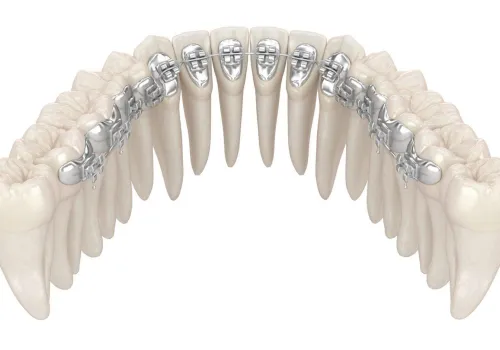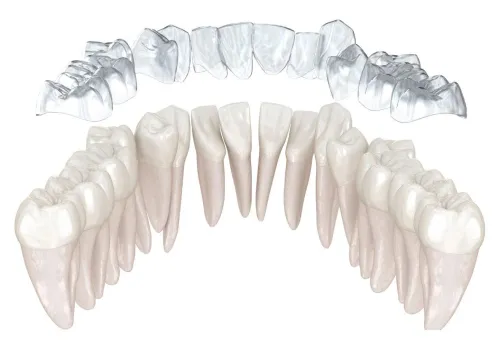
Straight teeth for adults too. We use fixed orthodontic appliances to move teeth precisely and effectively. Transparent brackets can be used to make them very discreet.


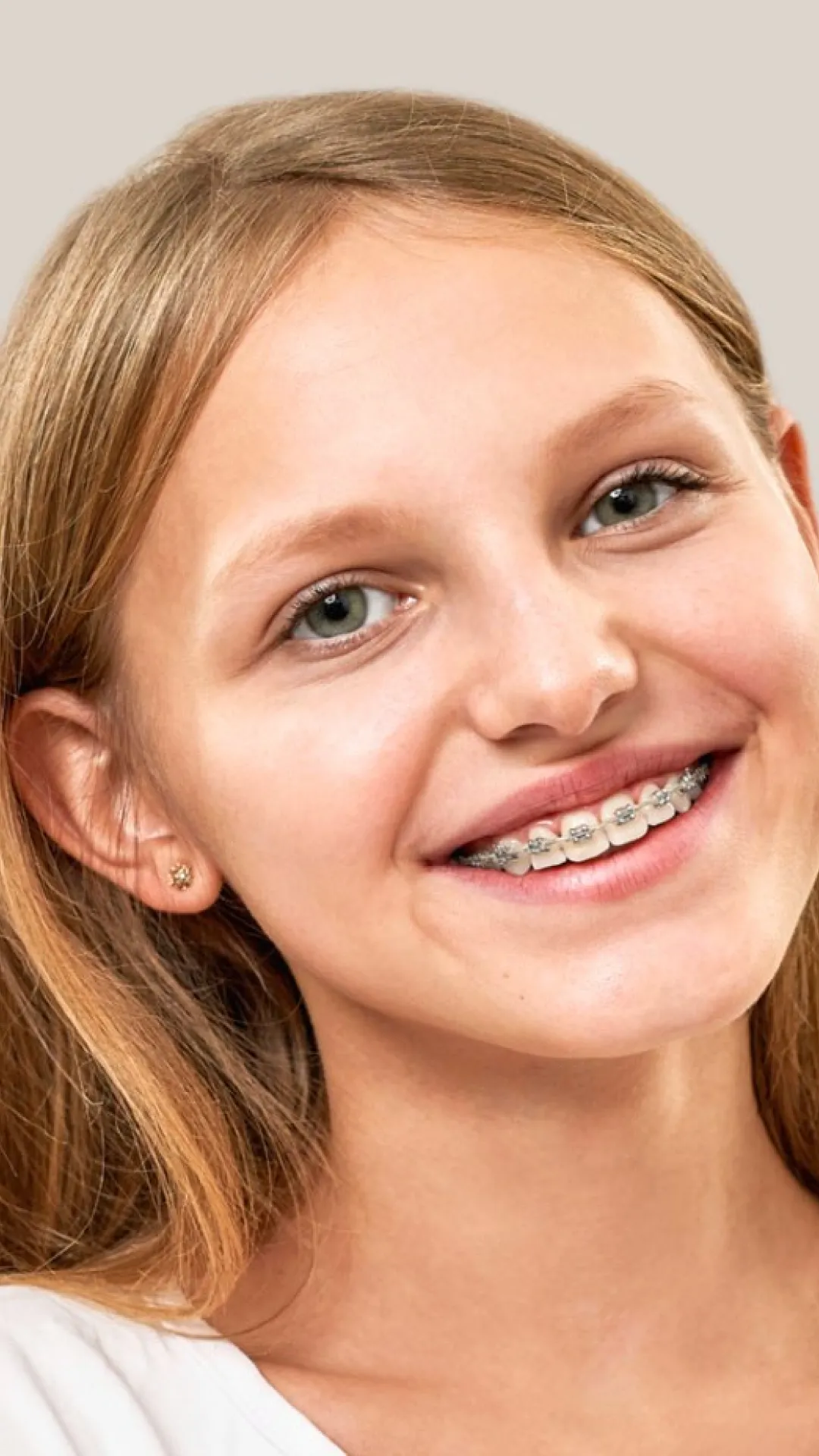

Straight teeth for adults too. We use fixed orthodontic appliances to move teeth precisely and effectively. Transparent brackets can be used to make them very discreet.
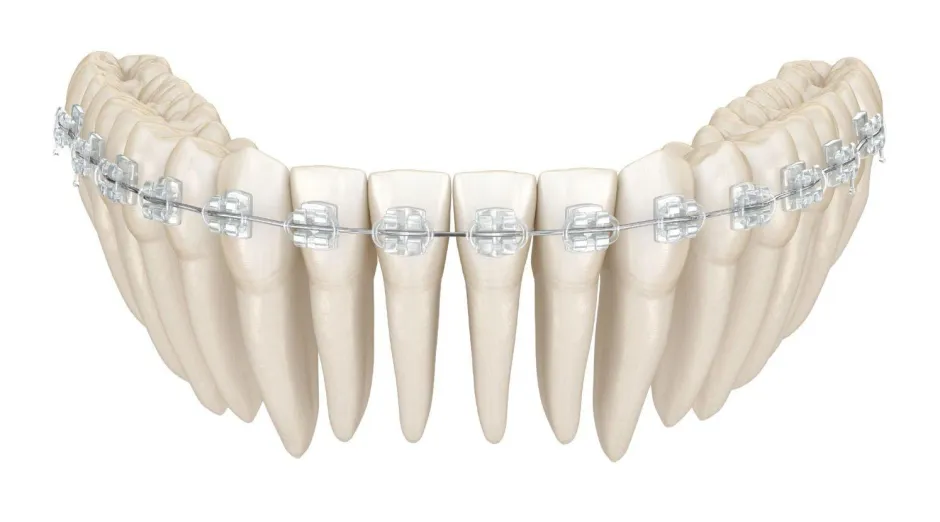
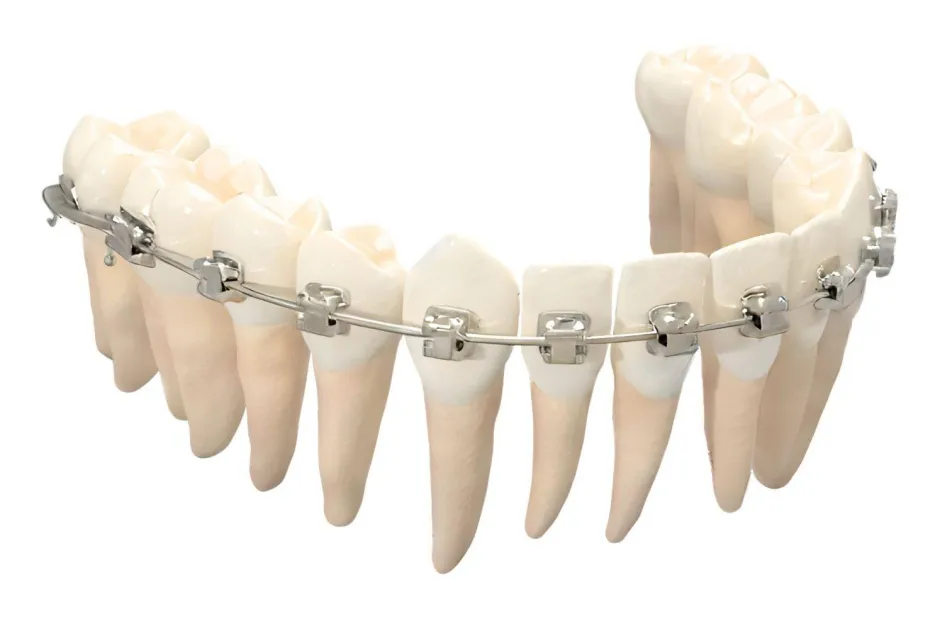
Traditional orthodontics with brackets and metal archwires - also known as multi-band or multi-bracket treatment - is still indispensable in many cases when it comes to targeted tooth position correction. The combination of flexible and rigid metal arches, which are now also available in white, can successfully correct even severe misaligned teeth.
In multi-bracket treatment, a specially shaped bracket is bonded to each tooth that is to be moved. A precisely shaped metal archwire fits into these brackets and is customised to the patient. Due to the elastic restoring force and the optimal arch form of the metal archwire, the teeth connected to the archwire are slowly and gently brought into a harmonious shape. Depending on the type of malocclusion and the individual situation, this process can take several months or even years, as teeth move very slowly.
Today, brackets are usually made of metal (mainly used in the treatment of children ) or white or transparent glass ceramic. The archwires are usually made of flexible metal alloys, which are often coloured white on the outside for aesthetic reasons.

The costs for correcting the position of teeth are very individual and depend on the specific task and the patient's situation. We would be happy to advise you personally on the subject of correcting the position of your teeth during a brief, free consultation in our practice.
You can find further prices for orthodontics and tooth position correction on our price list.
The widespread idea that brackets are only suitable for children and adolescents is long outdated. In modern orthodontics, brackets are now used just as successfully in adults as in young patients - and the proportion of adult patients in orthodontic practices is steadily increasing.
The key difference between treatment in adolescence and adulthood is that jaw growth in adults is complete. This means that certain corrections that are possible in children by guiding the still-growing bone must be achieved in adults solely by moving the teeth in the bone. In some cases, this can prolong the treatment time somewhat or - in the case of very pronounced skeletal misalignments - make oral surgery necessary.
However, for the vast majority of malocclusions - crowding, gaps, rotations, deep or crossbite - brackets are just as effective for adults as they are for younger people. Tooth movement works biologically at any age as long as the bone and gums are healthy.
A common concern of adult patients is aesthetics during treatment. Here, transparent or tooth-coloured ceramic brackets offer a very discreet alternative to classic metal brackets. In combination with white-coloured archwires, they are hardly noticeable in everyday life.
For adults with particularly high aesthetic requirements, lingual bracket systems (WIN, Incognito) are also available, which are completely attached to the inside of the tooth and are invisible from the outside. Orthodontics with brackets is therefore an effective, safe and increasingly discreet option for a beautiful, straight smile for adults of all ages.
The question of how painful bracket treatment is is one of the most frequently asked - and at the same time one of the most misunderstood. The honest answer is: brackets do not usually cause severe pain, but can lead to noticeable pressure and sensitivity during certain phases of treatment.
There is no pain when the brackets themselves are inserted, as the brackets are simply glued to the tooth surface - without drilling or cutting. However, the insertion of the first archwire can cause an unfamiliar feeling of pressure as the teeth begin to move. In the first two to three days after insertion or after an archwire fitting, many patients find their teeth sensitive - especially when chewing.
This sensation is completely normal and a sign that tooth movement is actively taking place. It usually subsides on its own after a few days. If necessary, over-the-counter painkillers such as paracetamol or ibuprofen can be taken for a short time - talk to your doctor or pharmacist briefly about this.
A common cause of discomfort - not necessarily pain - is pressure points on the cheeks, lips or tongue, which can be caused by the brackets or archwire ends. Orthodontic wax, which is pressed onto troublesome areas, provides immediate relief and is available from any pharmacy.
Over time, the mouth becomes so accustomed to the brackets that most patients hardly notice them. The feeling of pressure may return for a few days after follow-up visits with an archwire adjustment - but with each subsequent adjustment, the patient is already familiar with it and knows that it will pass. Overall, bracket treatment is well tolerated - even for sensitive patients.
Dental hygiene with brackets is one of the most important issues during treatment - and at the same time one that initially challenges many patients. Those who neglect oral hygiene during bracket treatment risk tooth decay, gum inflammation and permanent white spots on the enamel - and that would be a shame after all the time and effort invested.
The brackets and archwire create many new niches and surfaces where food debris and bacteria can accumulate. Cleaning is therefore more time-consuming than without brackets - but with the right tools and a little routine, it can be easily integrated into everyday life.
We recommend brushing with a soft toothbrush or an electric toothbrush, ideally after every meal. It is important to brush both above and below the brackets and to clean the gum line carefully. Special orthodontic toothbrushes with a V-shaped recess in the bristle arrangement make it easier to clean the area around the brackets.
Interdental brushes are indispensable: they clean the spaces between the teeth and the areas directly next to the brackets that cannot be reached with a normal toothbrush. In addition, dental floss with a floss threader or a water flosser (oral irrigator) are recommended to remove bacteria and debris from under the archwire.
A fluoride rinse after brushing strengthens the tooth enamel and prevents tooth decay - particularly important during bracket treatment. Your orthodontist or dental hygienist will show you the optimum individual brushing technique at the start of treatment and give you product recommendations. Regular professional dental cleanings every three to four months are also strongly recommended.
One of the most practical questions after having brackets fitted is: What can I eat with brackets - and what can I not eat? Certain foods can damage the brackets, bend arches or make oral hygiene more difficult. However, with a few adjustments, the diet remains varied and suitable for everyday use.
Hard foods that have a direct effect on the bracketsshould be strictly avoided: whole nuts and nut bars, ice cubes, hard bread and hard bread crusts, hard cheese in large pieces, cracked almonds and hard sweets and lollipops. These can loosen brackets from the tooth or bend the archwire - which means an unscheduled repair appointment.
Sticky and gummy foods are also problematic: Caramel, toffees, gummy bears, wine gums, chewing gum, dried fruit and sticky cereal bars get stuck between the bracket and archwire and are difficult to remove - they can also loosen the attachment of the brackets.
Hard fruit and vegetables such as apples, pears, carrots or cucumbers are generally allowed - but should be cut into small pieces instead of biting into them directly. The same applies to baguettes and other hard types of bread: bite-sized pieces are no problem.
Soft foods are largely unproblematic: Pasta, rice, potatoes, soft meat, fish, eggs, yoghurt, soft cheese, soups, smoothies and soft bread.
Strongly coloured foods and drinks such as coffee, tea or red wine can discolour the elastic rubber bands (ligatures) on the brackets - this is cosmetically unpleasant, but not a serious problem, as these are replaced at every check-up appointment.
The comparison of brackets vs. Invisalign is one of the most frequently asked questions in orthodontic practices - and the answer is not generalised, but depends on your individual situation, your priorities and the severity of the misalignment.
Brackets - whether metal or ceramic - are the classic, tried and tested method of orthodontics. They are firmly attached to the teeth and work around the clock without the patient having to actively participate. This is a major advantage: tooth movement is not dependent on the patient's wearing discipline. Brackets are often the more effective solution for complex malocclusions, severe rotations or difficult bite problems and can achieve more precise results than aligners in many cases.
Invisalign, on the other hand, works with a series of transparent, removable aligners. The main advantage lies in the aesthetics and flexibility: the aligners are practically invisible, can be removed for eating and brushing and do not restrict eating. The main disadvantage is that the splints have to be worn for at least 20 to 22 hours a day - if you do not do this consistently, you will prolong the treatment time or jeopardise the result.
For mild to moderate misalignments, both methods are generally similarly effective. Brackets are often superior for very demanding corrections. Transparent aligners or lingual brackets may be more attractive for patients who play sports, wind instruments or want extreme discretion.
The cost argument also plays a role: brackets are generally cheaper than Invisalign in Switzerland. Ask your orthodontist for individual advice - only a personal examination will show which method is the best solution for your specific situation.
The duration of treatment with brackets in adults varies greatly and depends on the type and severity of the misalignment, the reaction of the bone to the tooth movement and the co-operation of the patient. It is therefore difficult to make a generalised statement - however, the following guide helps to estimate the order of magnitude.
For slight misalignments - such as small crowding, minor rotation of individual teeth or slight gaps - bracket treatment in adults can be completed after just 12 to 18 months. For moderately severe cases with several teeth to be corrected and a slight bite issue, 18 to 24 months is realistic.
Complex malocclusions - pronounced crowding, severe bite problems, severe tooth rotation or cases where teeth have to be extracted - can take 24 to 36 months or longer. In rare cases that require oral surgery, the overall treatment may take even longer.
An important factor in adults is the biological reaction speed of the bone: as the bone in adults is denser and less reorganisable than in adolescents, teeth tend to move more slowly. However, this does not mean that the result is worse - it simply requires a little more patience.
The patient's co-operation also influences the duration: regular check-ups, good oral hygiene and the avoidance of bracket damage caused by unsuitable foods make a significant contribution to ensuring that the treatment proceeds according to plan and without unnecessary delays. The active phase is followed by the obligatory retention phase with a retainer, which secures the result permanently.
The time after bracket treatment is at least as important as the active treatment phase itself. Many patients underestimate what happens after the brackets are removed - and why a retainer is essential after braces.
Once the brackets are removed, the teeth naturally endeavour to return to their original position. This phenomenon is called recurrence and is a biological property of the periodontium. Without suitable measures, teeth that have just been straightened can begin to shift again within weeks to months.
To prevent this, a retainer is inserted immediately after the brackets have been removed. The most common form is the fixed retainer: a thin wire that is bonded to the inner surfaces of the front teeth (usually the lower, often also the upper teeth). This is invisible from the outside and holds the teeth permanently in their new position - without the patient having to actively do anything on a daily basis.
In addition or as an alternative, a removable retention splint can be used, which is initially worn every night and later only a few nights a week. Many orthodontists recommend a combination of both methods for maximum security.
The fixed retainer should be checked regularly by the dentist to ensure that it is firmly attached and no gum inflammation occurs. Cleaning the areas under and around the retainer wire requires floss flossers or a water flosser.
How long the retainer has to be worn is the legitimate follow-up question: most orthodontists recommend wearing it permanently - at least the fixed retainer. This may sound like a lot at first, but it is the only reliable way to secure the treatment results achieved over months or years in the long term.
The question of whether sports and music are possible with braces is a concern for many patients - especially children, teenagers and active adults. The good news is that in most cases both activities are still possible without any problems, with just a few adjustments.
One important rule applies to sports with brackets: when playing contact sports - i.e. sports where impact to the face or mouth area is possible - wearing a mouthguard is strongly recommended. This applies to martial arts (boxing, judo, karate), team sports with physical contact (basketball, handball, rugby, football) and winter sports. However, a normal mouthguard from the pharmacy is less suitable for brackets - an orthodontic mouthguard specially made for brackets is better, as it leaves more space for the brackets and offers optimum protection.
For endurance sports without contact risk - swimming, running, cycling, tennis - brackets are no obstacle. There is also no problem when swimming, as chlorinated water does not affect the brackets or the adhesive.
When making music with brackets, it depends on the instrument. There are no restrictions for string instruments, percussion or piano. With wind instruments, however, the familiarisation phase can take a little longer: Especially with brass instruments (trumpet, trombone, horn) and certain woodwind instruments, the brackets require an adjustment of the lip position and embouchure. Orthodontic wax can help to reduce pressure points on the lips and gums during the familiarisation phase.
With a little patience and practice, most musicians return to their usual playing feel after a few weeks. For serious musical requirements - such as professional musicians or ambitious young people in music lessons - it is worth discussing alternative orthodontic options such as Invisalign or lingual brackets.
The question of whether health insurance covers the costs of brackets in Switzerland is complex - and the answer depends largely on whether the patient is a child or an adult and what insurance cover is in place.
In Switzerland, compulsory health insurance (KVG, basic insurance) does not generally cover orthodontic treatment - regardless of whether brackets, aligners or other appliances are involved. This applies to the vast majority of orthodontic corrections that are carried out for aesthetic or functional reasons.
An exception applies to certain serious jaw and facial malformations, which are defined as orthodontic indication groups (KIG). In such cases, in which a malocclusion significantly impairs chewing function or health, benefits from basic insurance or disability insurance (IV) may be possible. The clarification of these indications is the responsibility of the treating orthodontist.
For children and adolescents, some cantons or certain supplementary insurances provide a contribution towards orthodontic treatment. It is worth enquiring about this directly with your own health insurance company and checking the insurance conditions.
Supplementary dental insurance can - depending on the policy - cover part of the orthodontic costs. Some supplementary insurance policies cover up to a certain amount per year or per treatment, others have specific exclusions. Before starting treatment, it is advisable to obtain a cost approval from the health insurance company and submit the orthodontist's quote.
Conclusion: In most cases, the costs for brackets are covered privately in Switzerland. A transparent cost estimate before starting treatment and checking any supplementary insurance benefits will help to avoid unpleasant surprises.
The question of whether brackets can permanently damage the teeth is a legitimate one and is asked by many patients. The honest answer: If brackets are fitted correctly and oral hygiene is good, the risk of permanent damage is low - but there are a few things you should be aware of.
White spots on the enamel are one of the most common undesirable side effects of bracket treatment. They are caused by localised decalcification of the enamel - directly around the brackets - as a result of poor oral hygiene and exposure to acid from bacterial plaque. These stains are permanent and can be cosmetically unpleasant once the brackets have been removed. They can be reliably prevented through consistent oral hygiene, fluoride application and regular professional dental cleanings.
Another possible side effect is so-called root resorption: the roots of the teeth shorten slightly in response to the orthodontic forces. Slight root resorption is biologically possible with bracket treatments and is usually not clinically relevant. It can be more pronounced with aggressive tooth movements, very long treatment times or individual predisposition. Regular X-ray checks during treatment allow the orthodontist to monitor the roots and adjust the treatment if necessary.
Gum problems can occur if oral hygiene is inadequate during treatment. Gingivitis (inflammation of the gums) is treatable and reversible - but chronic neglect can lead to permanent gum damage.
If brackets are planned and monitored by an experienced orthodontist, treatment is accompanied by regular check-ups and oral hygiene is consistently maintained by the patient, the risk of permanent damage is minimised. Bracket treatment is one of the best-researched medical treatments available - with a long, safe track record.