CD Logo2 white
Portrait eines lächelnden jungen dunkelhäutigen Mannes mit braunen kurzen Haaren und schönen weissen Zähnen. Der Hintergrund ist beige.

Embellish teeth Digital dentistry The future of diagnostics

Digital dentistry refers to the use of digital technologies in modern dentistry. This includes 3D X-rays, digital impressions with intraoral scanners, computer-aided planning systems and the digital production of dental prostheses using CAD/CAM technology. These procedures enable particularly precise, efficient and patient-friendly treatment.

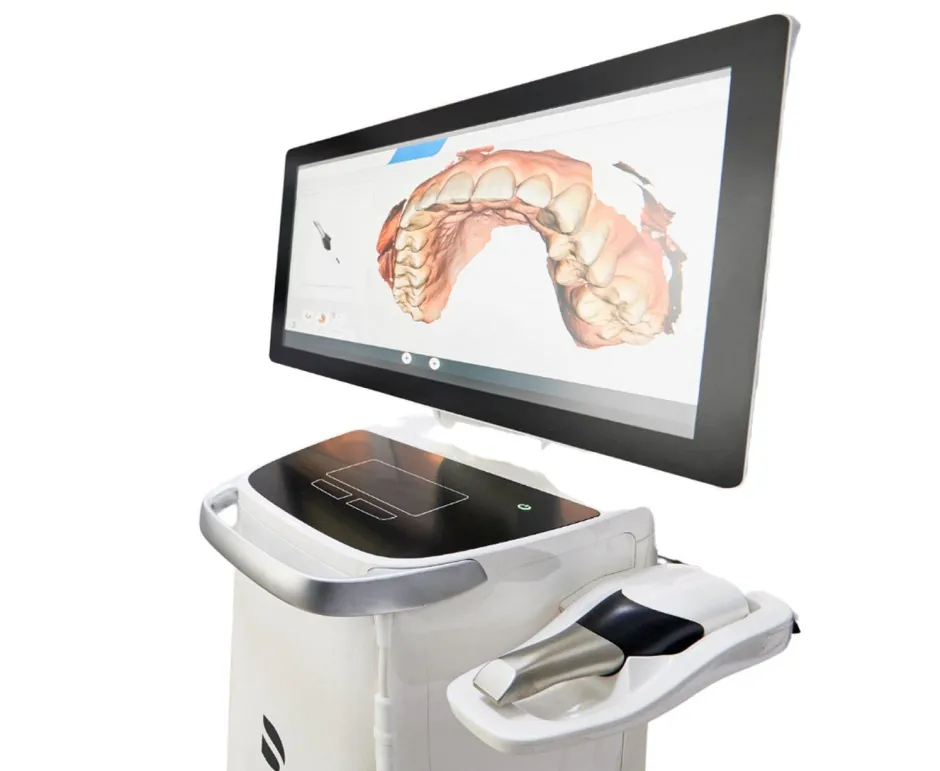
Foto eines Primescann von Dentsply Sirona auf dem ein Oberkiefer Scan zu sehen ist. Der Hintergrund ist weiss.

Where

Today, digital dentistry is used in many areas of modern dentistry and enables particularly precise, fast and patient-orientated treatment.

Applications include precise digital diagnostics, 3D-supported planning and realisation of implants, digital orthodontics and CAD/CAM production of crowns and bridges. In addition, digital communication with the dental laboratory optimises the accuracy of fit and shortens the duration of treatment.

Patient consultations also benefit greatly: thanks to digital visualisations, planned treatments can be clearly displayed and discussed with you - for maximum transparency and confidence in the treatment process.

When

Digital dentistry is not only used for complex dental procedures, but is also playing an increasingly important role in modern day-to-day practice work. Digital technologies help to improve treatment quality, optimise practice processes and significantly increase patient comfort.

Whether planning implants, taking digital impressions, fabricating dentures or informing patients - the advantages of digital dentistry are many and varied and make treatment more precise, more pleasant and more efficient.

Costs Digital planning & visualisation of a complete smile makeover

Best Price
CHF 990.-
  • Consultation & planning
  • 3D scan
  • Fitting of the new smile in the front of the upper jaw incl. video documentation to take home
Best Value
CHF 1'290.-
  • Consultation & planning
  • 3D Scan
  • Fitting of the new smile in the upper and lower jaw front incl. video documentation to take away
High End
CHF 1'990.-
  • Consultation & interdisciplinary planning by several specialists
  • 3D scan
  • Digital volume tomogram
  • Fitting of the new smile incl. video documentation to take away

FAQ: The most frequently asked questions about Digital dentistry

Digital technologies enable significantly greater precision, faster processes and better planning options than conventional methods. Modern procedures such as 3D X-rays, intraoral scanners and CAD/CAM systems provide precise data that can be processed directly. This means that treatments can be carried out not only more efficiently, but also more safely.

One major advantage is the reduction in sources of error, as manual intermediate steps are no longer necessary. Patients also benefit from greater comfort, for example through impression-free procedures. The duration of treatment can also often be significantly reduced, sometimes even to just one session.

In Switzerland, digital dentistry is increasingly becoming the standard, as it offers both medical and organisational benefits. Overall, it ensures more efficient, more comfortable and more reliable treatments in the long term.

Many patients wonder whether digital dentistry is actually more accurate than traditional procedures.
The answer is yes, in most cases. Digital technologies allow for micron-level accuracy and generally have less variance than traditional impression methods.

An intraoral scanner, for example, can precisely capture the tooth structure and immediately visualise it as a 3D model. This data is used directly for the planning and manufacture of dentures. This results in fewer inaccuracies and fitting problems.

In diagnostics, too, digital procedures such as 3D volume tomography provide significantly more detailed information than conventional X-ray images.

Overall, digital precision leads to better fitting restorations, fewer touch-ups and higher treatment quality.

The safety of digital dentistry is a key issue for many patients. Modern digital procedures are considered to be very safe as they enable precise planning and controlled implementation.

Important structures such as nerves or bones can be precisely visualised using 3D X-ray diagnostics. This allows risks to be recognised and avoided in advance.

Another advantage is the lower radiation exposure with digital X-ray procedures compared to conventional methods.

In Switzerland, digital systems are subject to strict quality standards. Overall, digitalisation helps to make treatments more predictable, less risky and more transparent.

The question of the cost of digital dentistry is particularly common. In principle, the treatment may initially seem a little more expensive as modern technologies are used.

In the long term, however, it can save costs as errors are reduced, treatment times are shortened and reworking is minimised.

A crown made in a dental laboratory usually costs an average of CHF 1700 - 2000, whereas a fully digital CEREC crown costs only CHF 1200 - 1500, which corresponds to an average cost saving of around CHF 500 per crown.

Another factor is efficiency: digital processes enable faster procedures and fewer appointments. This results in fewer indirect costs, such as time spent.

In Switzerland, the price depends heavily on the specific treatment. It is important to understand that digital dentistry often represents an investment in quality and longevity.


Digital technologies are used in many areas, but implantology, dentures and orthodontics benefit in particular.

In the case of implants, digital planning enables precise positioning, which significantly increases the success of treatment.

CAD/CAM technology also ensures precise results for crowns, bridges and inlays. In addition, digital models and simulations make orthodontics more precise and easier to plan.

Overall, digital dentistry is particularly useful where precision, planning and customisation are crucial.

Many patients are interested in the possibility of having dentures made in just one session. Thanks to modern CAD/CAM technology, this is now possible in many cases.

The tooth is digitally scanned, designed on the computer and milled directly in the practice. The denture can then be inserted immediately.

This so-called "same-day dentistry" saves time and significantly reduces the number of appointments.

In Switzerland, this method is being used more and more frequently, especially for inlays and crowns. It offers a fast, convenient and efficient solution for patients.

An intraoral scanner is a key tool in digital dentistry. It replaces the classic impression and creates a digital 3D image of the teeth.

The device is guided in the mouth and records the tooth surfaces without contact using laser triangulation. The data is immediately displayed on a screen and can be processed further.

A major advantage is the increased comfort, as no impression material is used. This is particularly helpful for patients with a gag reflex. In addition, the results are very precise and immediately available.

In modern dentistry, the intraoral scanner is an important component for precise diagnostics and high-quality treatments.

Yes, digital X-rays (DVT or digital single exposures)reduce the radiation dose by up to 90 % compared to conventional X-rays. The images are immediately available, easier to analyse and do not need to be chemically developed - a clear advantage for patients and the practice.

CAD/CAM stands for "Computer Aided Design / Computer Aided Manufacturing". In dentistry, this technology enables the computer-aided planning and manufacture of dental prostheses such as crowns, bridges or inlays - often on the same day in the dental practice. This saves time and often makes additional sessions superfluous.

Despite the many advantages, there are also questions about the disadvantages of digital dentistry.

One possible disadvantage is that the technology is heavily dependent on software and technology. Errors or technical problems can affect the process, but are fortunately rare.

Overall, the advantages clearly outweigh the disadvantages. Digital procedures offer greater precision, more comfort and better planning options than traditional methods.

In Switzerland, the technology is being continuously developed and optimised.

A DVT is a three-dimensional X-ray procedure that provides detailed images of the jaw, teeth and neighbouring structures. In Switzerland, it is often used for planning implants, root canal treatment or orthodontic treatment. CBCT enables precise diagnosis with minimal radiation.

In digital implant planning, the optimum position of the implant is planned on the computer based on a 3D X-ray image (DVT) and a digital dental impression. The implant is then placed with millimetre precision using a custom-made drilling template. This procedure increases safety and shortens the operation time.

Digital dentistry offers great advantages, especially for children and people with dental anxiety: Digital impressions avoid the unpleasant gag reflex of classic impressions, treatments are shorter and more precise, and the latest diagnostic technology means that stressful procedures can often be avoided.
Many Swiss dental practices are therefore focussing on digital technologies to make visits as pleasant as possible.