The oldest problems often require the most modern solutions. Nitrous oxide and twilight sedation are a more cost-effective alternative to general anaesthetic treatment for patients with dental anxiety.



The oldest problems often require the most modern solutions. Nitrous oxide and twilight sedation are a more cost-effective alternative to general anaesthetic treatment for patients with dental anxiety.
We usetwilight sedation and nitrous oxide analgesia to offer patients with dental anxiety or dental phobia a gentle, well-tolerated and cost-effective alternative to general anaesthesia.
During twilight sedation, the patient is given a tablet containing a strong sedative one hour before the start of treatment. The dosage depends on the patient's body weight and the duration of the procedure.
After the procedure, you should be collected and never drive yourself.
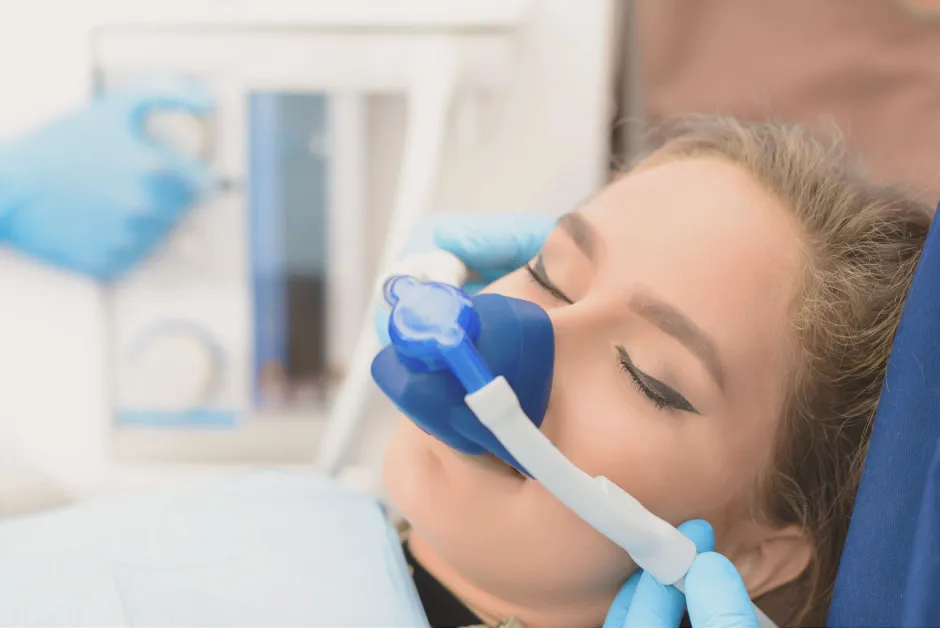
During nitrous oxide analgesia, the gas nitrous oxide is administered via a nasal mask before the procedure begins. This has a strong anti-anxiety and pain-relieving effect.
The cost of twilight sedation depends on the degree of monitoring and the duration of the procedure. The anaesthetist will clarify this with you before the procedure during the preliminary consultation.
We can offer nitrous oxide analgesia from around CHF 100 per hour , which is relatively inexpensive compared to a general anaesthetic, which often costs around CHF 950 per hour.
The question of what nitrous oxide feels like at the dentist is one of the most frequently asked by patients who are not yet familiar with this method and want to know what to expect. The subjective experience varies from person to person, but there are typical sensations that most patients describe.
After just a few breaths through the nasal mask, nitrous oxide begins to take effect. The first thing most patients feel is a warming, tingling sensation - often starting in the fingertips, the tips of the toes or the face - which spreads pleasantly and relaxingly over the whole body. This tingling sensation is completely harmless and is a sign that the nitrous oxide is taking effect.
At the same time, there is a clear relaxation and reduction in anxiety: worries and tension fade into the background, the body relaxes and many patients describe a feeling of lightness or slight weightlessness. The mind remains clear - you are fully conscious, can speak, answer questions and give signals to the dentist. They are aware of the treatment, but find it much less stressful and frightening.
Some patients report a slight feeling of dizziness or light-headedness - similar to after a glass of wine. Some experience a slight buzzing or roaring in the ears, but this quickly normalises. The sense of time may change: Procedures that take longer often feel shorter than they actually are.
The laughter that gives the gas its name does not always occur - laughing gas lifts the mood, but does not automatically trigger fits of laughter in everyone. For most patients, laughing gas is simply a pleasant, calming experience - without unconsciousness, without unpleasant after-effects and without fear.
The safety of nitrous oxide at the dentist is one of the most common questions asked by patients considering this method. The reassuring news is that nitrous oxide is one of the best researched and safest sedation methods in dentistry and has been used for over 150 years.
Laughing gas (nitrous oxide, N₂O) is a colourless and odourless gas that is administered together with oxygen via a nasal mask. It works quickly, can be precisely dosed and - this is a major advantage - subsides just as quickly: the gas is completely exhaled from the body just a few minutes after the end of the administration and most patients can leave the practice without restrictions and drive themselves home.
Possible side effects of nitrous oxide include: mild nausea (especially if the dose is increased too quickly or if the patient is fasting), dizziness, tingling in the extremities and, in rare cases, headaches. These side effects are generally mild and subside as soon as the nitrous oxide supply is stopped.
Contraindications - situations in which nitrous oxide should not be used - include: pregnancy (especially in the first trimester), certain respiratory diseases such as COPD or severe asthma, middle ear infections, certain psychiatric illnesses and a known vitamin B12 deficiency (as nitrous oxide can affect B12 utilisation). People who suffer from claustrophobia sometimes find the nasal mask uncomfortable.
When used correctly by an experienced dentist and in compliance with the contraindications, nitrous oxide is an extremely safe method - with a significantly lower risk profile than twilight sedation or general anaesthesia.
The question of whether you need to be sober for nitrous oxide at the dentist is particularly relevant for patients who make an appointment spontaneously or who want to minimise changes to their everyday life. The good news: compared to general anaesthesia or twilight sedation, the sobriety requirements for nitrous oxide are much more relaxed.
As a rule, nitrous oxide analgesia does not require strict fasting, as is the case before a general anaesthetic. As nitrous oxide does not switch off consciousness and the protective reflexes (such as swallowing and coughing reflexes) are retained, there is no increased risk of aspiration. There is therefore no medical reason for a six- to eight-hour fasting period.
Nevertheless, most dentists recommend avoiding heavy meals two to three hours before the appointment. The reason: a full stomach can increase the risk of nausea during nitrous oxide treatment.
A light snack - a yoghurt, some bread or a piece of fruit - is usually fine or even recommended. Coming to a nitrous oxide treatment completely without a meal beforehand can, in rare cases, lead to nausea or a brief syncope (fainting) in patients with low blood pressure.
As far as drinking is concerned, small amounts of water or clear liquids are usually allowed until just before the appointment - your dentist will give you precise recommendations for your specific situation.
The more liberal fasting requirements are one of the major practical advantages of nitrous oxide over other forms of sedation: It's more flexible to schedule into your daily routine, and patients don't have to adjust their daily routine as much. Nevertheless, check with your practice in advance whether there are specific instructions for your planned treatment.
The question of driving after nitrous oxide at the dent ist is of great practical importance for many patients - especially those who come to the dentist's appointment alone. And this is one of the main advantages of nitrous oxide over other forms of sedation.
Yes - as a rule, you can drive yourself after a nitrous oxide treatment, provided that the standard waiting time after the end of the nitrous oxide supply has been observed. Nitrous oxide is exhaled by the body exclusively through the lungs - it is not metabolised and leaves no degradation products in the blood. This means that the gas is completely eliminated from the body approx. 15 minutes after the end of the nitrous oxide supply - during which the patient breathes pure oxygen through the mask.
After this short post-ventilation phase, most patients are able to react and concentrate fully again. This distinguishes nitrous oxide fundamentally from twilight sedation or general anaesthesia, after which driving for the entire day - or even longer - is prohibited.
Nevertheless, there are individual differences: some patients who have reacted strongly to nitrous oxide or are more sensitive to the gas still feel slightly dizzy after the treatment. In such cases, you should wait a little longer in the practice to be on the safe side before you get behind the wheel - and if in doubt, you should ask someone to accompany you or take a taxi.
The following also applies: If additional medication was administered during the nitrous oxide treatment (e.g. an oral sedative as a supplement), the driving fitness rules of the stronger medication apply - in this case, driving is prohibited for the rest of the day. Clarify this question explicitly with your dental team in advance.
The question of who nitrous oxide at the dentist is suitable for is a concern for many patients who are looking for a gentle solution to their dental anxiety. Nitrous oxide is a broad and versatile method - but there are situations where other options are more suitable.
Nitrous oxide iswell suited for patients with mild to moderate dental anxiety who are generally cooperative but require additional relaxation and anxiety reduction during treatment. Nitrous oxide is also an excellent aid for patients with a strong gag reflex - a common problem when taking impressions, cleaning teeth or working in the back of the mouth - as it significantly reduces the gag reflex.
For children from around four years of age, laughing gas is a proven and very well-tolerated method of improving co-operation during dental procedures. Many children experience treatment with laughing gas as hardly stressful and have no negative memories afterwards.
For patients who can tolerate short to medium-length procedures (up to around 60-90 minutes) without sufficient local anaesthesia, nitrous oxide is also an effective supplement that significantly increases comfort.
However, nitrous oxide isnot suitable or only suitable to a limited extent for pregnant women (especially in the first trimester); patients with known vitamin B12 deficiency or diseases that impair B12 utilisation; patients with severe respiratory diseases such as COPD, uncontrolled asthma or obstructions of the nasal passages (as it is administered via a nasal mask).nasal obstructions (as it is administered via a nasal mask); with active middle ear inflammation (nitrous oxide can enlarge gas bubbles in the middle ear) and with very severe dental phobia, where nitrous oxide alone is not sufficient and twilight sedation or general anaesthesia is necessary.
The duration of the effect of twilight sedation at the dentist is an important planning factor for patients - both for the organisation of the treatment day and for planning aftercare. The answer depends on the sedative used, the dosage and the patient's individual metabolisation.
In oral twilight sedation - i.e. the method in which a sedative is administered as a tablet or drop - midazolam or a similar benzodiazepine is often used. These substances usually take effect after 30 to 60 minutes (which is why the tablet is taken one hour before the procedure) and their sedative effect lasts for four to eight hours, depending on the dosage and individual metabolism.
This means that even if the patient feels relatively clear again after the procedure, they are still impaired for several hours - even if they do not feel this way subjectively. Reactivity, judgement and coordination are still impaired. For this reason, the following applies for the hours after twilight sedation: no driving, no important decisions, no alcohol and no operation of machines.
With intravenous sedation (propofol or midazolam via the vein), awakening is generally somewhat quicker - the effect subsides significantly after two to four hours. Here too, however, full recovery takes the rest of the day.
Do not plan any professional or private commitments that require concentration or responsibility for the day of the twilight sedation. Ideally, you should spend the rest of the day at home in peace and quiet - ideally with a carer at your side. The next day, most patients are fully recovered and can resume their normal daily routine.
In modern paediatric dentistry,laughing gas at the dentist for children is one of the most important and proven methods for helping young patients through dental treatment in a relaxed, cooperative and positive manner. Many practices use nitrous oxide regularly and very successfully with children.
At what age is nitrous oxide suitable for children? Most dentists start using laughing gas from around the age of four, as soon as the child is able to tolerate the nasal mask and follow instructions. Younger children are often not yet ready to hold the mask still on their nose - which makes it difficult to administer.
The great advantage of nitrous oxide in children is that it does not involve a needle, syringe or unconsciousness. The mask is simply placed on the nose and within a few minutes the child feels pleasantly relaxed and calm. The treatment can then be carried out calmly and with much less resistance. Many children describe the experience afterwards as not frightening and have no negative memories.
Nitrous oxide in children is particularly suitable for: caries treatment, tooth extractions in primary dentition, fillings, professional dental cleanings in sensitive children and in cases of severe gag reflexes, which make many childhood procedures more difficult.
The safety of nitrous oxide in children is well documented and is recommended by international paediatric dental societies as the first choice for mild to moderate uncooperativeness. The dosage is carefully adjusted to the child's body weight and age. As there are no long-lasting after-effects, children can eat and play normally again after the appointment - everyday life is hardly affected.
The comparison of nitrous oxide vs twilight sed ation is particularly relevant for patients who are considering for the first time which sedation option is best suited to their situation. Both methods help to reduce anxiety and stress during dental treatment - but in very different ways.
Nitrous oxide is the lighter of the two options. It is inhaled as a gas through a nasal mask, takes effect within one to two minutes and subsides just as quickly. The patient remains fully conscious, can speak, co-operate and has control over their body. The reduction in anxiety is clear, but the experience of the treatment remains conscious. Nitrous oxide is suitable for mild to moderate dental anxiety and short to medium-length procedures. After-effects are minimal and driving is permitted again after a short waiting period.
Twilight sedation is a deeper level of altered consciousness. In the oral version, a sedative tablet (benzodiazepine) is taken, which puts the patient into a drowsy, relaxed twilight state - awake enough to respond to speech, but relaxed enough to feel hardly any anxiety. With the intravenous variant (e.g. with Propofol), the sedation is deeper and many patients have little or no memory of the procedure. Twilight sedation is suitable for moderate to severe dental anxiety, longer procedures and patients for whom nitrous oxide alone is not effective enough.
The most important practical differences: After nitrous oxide you can often drive yourself home, after twilight sedation an accompanying person is mandatory and driving is prohibited for the entire day. The price of laughing gas is significantly cheaper. Neither method is sufficient for very severe phobias - in this case, a general anaesthetic is the more suitable solution.
The question of whether the costs of nitrous oxide and twilight sedation are covered by health insurance in Switzerland is relevant for many patients - and the answer depends on the indication and the insurance model.
Compulsory basic insurance (KVG) does not generally cover dental treatment and therefore also sedation. As dental services are generally excluded from the KVG benefits catalogue, the costs of nitrous oxide or twilight sedation for normal dental treatment (e.g. fillings, extractions) are also covered privately.
However, there are important exceptions: If sedation is necessary due to a recognised medical or psychological indication - for example, for patients with severe, documented dental phobia with a psychiatric diagnosis, for children with developmental disorders or for certain neurological conditions - it may be possible for the health insurance company to share the costs in individual cases. These cases are clearly defined and must be clarified individually with the health insurance company. Medical documentation of the indication is essential.
In the case of children with disabilities or behavioural problems for whom dental treatment is not possible without sedation, benefits from disability insurance (IV) may be possible under certain circumstances - including for the sedation costs.
Depending on the tariff and provider,supplementary dental insurance policies offer cost sharing for dental treatment - in some policies, sedation costs are also partially covered. It is worth checking your own supplementary insurance for corresponding clauses and requesting a written cost approval before the procedure.
As a general rule, both nitrous oxide (from around CHF 100 per hour) and twilight sedation are cost-effective options compared to general anaesthesia - and in most cases can be regarded as a reasonable co-payment for a much more pleasant treatment experience.
The question of whether you can still communicate with the dentist during twilight sedation is important for many patients - partly for practical reasons (e.g. whether you can report pain) and partly because you don't want to lose control completely.
The short answer: yes, usually yes - but in different ways, depending on the depth of sedation.
With oral twilight sedation (sedative tablet), the patient is in a drowsy, relaxed state, but is still awake enough to respond to direct speech, answer simple questions and give signs. For example, you can answer the question "Do you feel pain?" or raise your hand if something becomes uncomfortable. This residual ability to cooperate is an important difference to general anaesthesia and a major advantage: the dentist can assess the situation at any time and evaluate the patient's experience.
In the case of intravenous sedation with propofol or midazolam, the depth of sedation is individually variable. With light sedation, communication remains possible; with deeper sedation, the patient is barely responsive - but still not unconscious like under general anaesthesia.
Why is this important? Because it means that the dentist can react immediately in emergencies or unexpected situations by addressing the patient. In addition, communication is important for the quality control of certain work steps - for example when checking the bite after a filling or crown.
Patients should also be aware of this: Although they can communicate to some extent during twilight sedation, many have little or no memory of the procedure - which is precisely what is desired for many anxious patients. The procedure "happens" in a pleasant twilight state and you wake up afterwards without any traumatic memories.