Fixed teeth in just one day are no longer wishful thinking. Thanks to innovative surgical techniques and computer-aided planning, we can fulfil this wish and give toothless patients a fixed bite again in just one day.




Fixed teeth in just one day are no longer wishful thinking. Thanks to innovative surgical techniques and computer-aided planning, we can fulfil this wish and give toothless patients a fixed bite again in just one day.
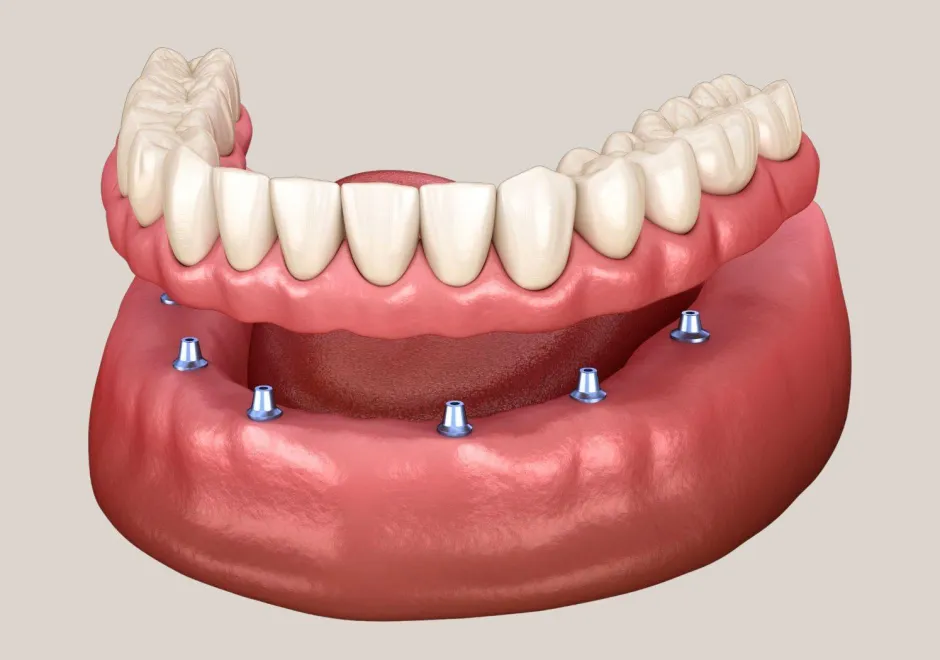
We use the ALL-ON-4® procedure (also known as Pro Arch or "Tooth in 1Hour") for patients who are edentulous in one or both jaws or have only a few severely damaged teeth left. These patients often suffer from the impact of unsightly dentures on their appearance or are unable to eat everything they want because poorly fitting dentures or loose teeth prevent them from doing so.
The procedure is particularly favoured by patients with busy careers who cannot afford or do not want to miss long periods of work.
The advantage of the ALL-ON-4® procedure is that a fixed bridge can be inserted immediately after the removal of teeth that are no longer worth preserving, using only 4 implants per jaw that are connected to each other. As a rule, there is no need for a temporary restoration, which saves the patient considerable costs for temporary dentures (approx. CHF 1500 per jaw).
Thanks to a special implant insertion technique and 3-dimensional computer-aided planning, this is also possible for patients with severe bone loss (e.g. due to years of wearing a full denture or after an accident) who would otherwise require expensive bone augmentation.
Like conventional implants, the implants for the ALL-ON-4® procedure are made of high-purity grade 5 titanium, which is also used for knee and hip prostheses. This material is extremely biocompatible, very resilient and extremely well tolerated.
The bridges screwed onto the implants consist of a precision-manufactured titanium or all-ceramic framework and are fitted with natural-looking ceramic teeth.
The cost for one jaw is around CHF 20,000. For wearers of full dentures who want fixed teeth again, we can often offer a price of CHF 19,000 per jaw.
In addition, there is only the cost of a general anaesthetic if the patient so wishes.
The durability of All-on-4 implants is one of the key questions for patients interested in this treatment - after all, it is one of the biggest investments you can make in your own oral health. The good news is that with the right care and regular check-ups, All-on-4 implants are designed to last a lifetime.
The implants themselves - the titanium posts that are anchored in the jawbone - have a very high success rate: long-term studies over 10 to 15 years show that over 95 per cent of implants remain permanently stable in the bone. Titanium is a material that is almost completely tolerated by the body and grows firmly into the bone through a process called osseointegration. This connection is usually so stable that the implants can last a lifetime.
In contrast, the bridge on the implants - i.e. the visible dentures - is subject to a certain amount of wear and tear and typically needs to be replaced after 10 to 20 years. The exact lifespan depends on the material (titanium or zirconium oxide framework, ceramic veneer) as well as chewing behaviour and care. Patients with severe bruxism (grinding and clenching) should wear a protective splint at night to protect the bridge.
Consistent oral hygiene is crucial for the longevity of the entire All-on-4 system: regular cleaning with suitable aids, professional dental cleanings every three to six months and regular check-ups are essential. With good care and healthy lifestyle habits - especially non-smoking - the All-on-4 procedure is a very long-lasting solution for firm, functional and aesthetically pleasing teeth.
Aftercare after All-on-4 is a decisive factor for the long-term success of the treatment. After the procedure, many patients are relieved to leave the practice with fixed teeth on the same day - but the healing phase and proper aftercare are just as important as the operation itself.
In the first 24 to 48 hours after the procedure, you should avoid physical exertion and rest sufficiently. Swelling, slight pain and a general feeling of pressure are completely normal during this phase. Cooling packs placed gently on the cheeks from the outside help to reduce swelling. Consistently take the painkillers and antibiotics prescribed by your dentist - they support healing and prevent infections.
Diet plays an important role during the healing phase: in the first six to eight weeks after the procedure, you should only eat soft foods - soups, yoghurt, purees, soft meat, fish and the like. Hard, chewy or crunchy foods can put a strain on the freshly placed implants and disrupt the healing process. After the healing phase, you can gradually return to your normal diet.
Oral hygiene must be carried out carefully right from the start: Gentle rinsing with an antiseptic mouthwash in the first few days, followed by regular, careful brushing with a soft toothbrush. Special interdental brushes and water flossers help to keep the areas under and around the bridge clean.
Regular follow-up appoint ments - initially weekly, later monthly and finally quarterly to half-yearly, depending on oral hygiene - allow the treatment team to monitor osseointegration and intervene early if necessary. These follow-up appointments are not optional, but an integral part of the All-on-4 concept.
One of the most common reasons why patients originally believe they are not suitable for implants is severe bone loss in the jaw. This is precisely one of the greatest advantages of the All-on-4 procedure: it was developed specifically for patients who have significant bone loss - and is therefore often an option even if individual standard implants are no longer possible.
The key trick of the All-on-4 concept lies in the inclined positioning of the two rear implants: These are not inserted into the jaw vertically, but at an angle of up to 45 degrees. This allows them to be anchored in areas where there is still sufficient bone volume - typically further forward in the jaw, where bone loss is less pronounced.
This clever positioning means that in many cases there is no need for the costly bone augmentation (bone augmentation) that would be necessary with conventional implants. This is an enormous advantage for patients: fewer surgical steps, shorter treatment duration, lower costs and a faster result.
However, the All-on-4 procedure also has its limitations: In cases of extreme bone loss - when the bone has receded to such an extent that stable anchoring is not possible even with inclined implants - bone augmentation may still be necessary before implants can be placed.
Whether All-on-4 is possible for your bone condition is assessed by a three-dimensional computerised tomography (CBCT) scan and thorough planning. This examination shows the implantologist exactly how much bone is present, where it is densest and how the implants can be optimally positioned. You will receive a clear assessment of your individual situation in a personal consultation.
For many patients, the question of pain during the All-on-4 procedure is one of the most important before making a decision - and is understandably associated with a certain amount of concern. After all, it is a surgical procedure in which implants are placed in the jawbone. However, the reality is much more pleasant than expected for most patients.
You will not feel any pain during the procedure itself: the treatment is carried out either under local anaesthetic or, if desired, under general anaesthetic or twilight sleep (sedation). Pressure, vibration and noise are possible during the procedure - but no pain is felt. You will discuss the choice of anaesthesia with your treatment team in advance.
In the first 24 to 72 hours after the procedure, a feeling of pressure, pulling or dull pain in the jaw area is normal and to be expected. Most patients describe the post-operative discomfort as well tolerated, especially if the prescribed painkillers are taken consistently. In addition to pain, swelling and occasional bruising (haematomas) may also occur in the cheek and jaw area - these are harmless and usually subside within a week.
After about one to two weeks, the situation normalises significantly for most patients. During this time, the implants integrate into the bone - a process that takes three to six months and is usually completely pain-free.
Patients who are particularly worried about pain or are very anxious are advised to discuss the possibility of a general anaesthetic or sedation. In such a relaxed environment, many patients experience the procedure as hardly stressful and report afterwards that their fears were far exceeded.
One of the greatest quality of life improvements that the All-on-4 procedure brings is the return to almost unrestricted eating pleasure. Patients who have lived for years with ill-fitting dentures or missing teeth often experience profound relief after the restoration - eating becomes a pleasure again.
During the healing phase - i.e. in the first six to eight weeks after the procedure - clear restrictions apply: Only soft, gentle foods are allowed. This includes yoghurt, soups, mashed potatoes, soft meat, fish, eggs, soft bread and the like. Hard, chewy or crunchy foods can mechanically stress the freshly placed implants during this phase and jeopardise osseointegration (bone-implant connection).
After the implants have fully healed and the definitive bridge has been inserted - usually after three to six months - most patients can eat almost anything they want again: Meat, bread, apples, nuts, raw vegetables, crusty baguettes. The bite function of the All-on-4 bridge is comparable to that of natural teeth and significantly better than that of a conventional denture.
However, there are some permanent recommendations: Extremely hard foods - such as whole nuts in the shell, chewing ice cubes or very hard sweets - should be avoided, even with fixed implant teeth, as they can mechanically overstress the bridge. Patients with bruxism should also wear a protective splint to protect the bridge from excessive wear.
Overall, the All-on-4 procedure enables a return to a normal quality of life when eating - one of the greatest gifts that modern implantology has to offer patients with tooth loss.
Cleaning All-on-4 teeth is an issue that concerns all patients after the procedure. Although the bridge is fixed and feels like real teeth, it needs a specific care routine - because bacteria and debris can accumulate under and around the bridge, which can lead to peri-implantitis (inflammation around the implant) in the long term.
The centrepiece of daily care is cleaning the areas between the bridge and the gums: as the bridge is screwed onto the four implants and lies above the gums, there is a gap underneath that needs to be cleaned carefully. The most effective tools for this are Superfloss dental floss (with a stiff end that can be passed under the bridge), suitably sized interdental brushes and a water flosser (oral irrigator), which flushes the areas under the bridge with a jet of water.
The visible surfaces of the bridge are brushed with a soft toothbrush or an electric toothbrush and a fluoride-free or mild toothpaste - as strong abrasives can attack the ceramic surface. Brushing should be done twice a day and the underside should be cleaned at least once a day.
Professional dental cleanings by a dental hygienist are particularly important for All-on-4 patients: ideally every three to four months, so that professional instruments can reach the areas that cannot be completely cleaned with household products. Special instruments for implants - made of titanium or plastic instead of metal - prevent scratches on the implant surface.
With the right care routine, the All-on-4 restoration remains healthy, hygienic and aesthetically perfect in the long term - and the implants can remain stable for a lifetime.
The question of whether smokers can receive All-on-4 implants is an important one and is frequently asked in practice. The honest answer is that smoking is one of the biggest risk factors for implant failure - but it does not necessarily mean that treatment is out of the question.
Nicotine and the numerous harmful substances in cigarette smoke have a negative effect on healing on several levels: they reduce blood flow to the tissue, inhibit the immune defence, slow down wound healing and disrupt osseointegration - i.e. the ingrowth of the implants into the bone. Studies clearly show that the risk of an implant not healing or being lost in the long term is two to three times higher in smokers than in non-smokers.
In practice, this means that patients who smoke and want All-on-4 treatment are strongly advised to stop smoking before the procedure - ideally at least two weeks before the operation and for at least two to three months afterwards. This period covers the critical phase of osseointegration, during which the implants must heal safely.
Many patients use the upcoming treatment as motivation to give up smoking permanently - a decision that benefits oral health and overall health in equal measure.
Patients who wish to continue smoking despite being informed can still be treated in some cases - but with increased risk awareness on both sides. In such cases, the treatment team openly discusses which risks are being taken and how these can be minimised. An individual risk assessment in a personal discussion is essential.
The All-on-4 vs All-on-6 comparison is a common question as soon as patients start to look more closely at implant-supported full tooth replacement. Both concepts pursue the same goal - anchoring a complete dental arch on a few implants - but differ in some key aspects.
In the All-on-4 procedure, the entire dental arch is fixed on four implants per jaw. Two of these are placed vertically in the anterior region of the jaw, while two others are tilted (at an angle of up to 45 degrees) in the posterior region of the jaw. This tilt makes it possible to find stable anchorage points even when there is little bone available - without bone augmentation.
The All-on-6 procedure uses six implants per jaw. In theory, the additional two implants offer a wider load distribution and more stability - especially in the area of the posterior teeth, where the chewing forces are greatest. All-on-6 can therefore be an attractive option for patients with sufficient bone volume.
In clinical practice, however, long-term studies show that the success rates of All-on-4 and All-on-6 are comparable - provided that planning and realisation are carried out by an experienced team. The All-on-4 concept offers the advantage of being less invasive (fewer implants, fewer procedure sites), which tends to reduce healing time and risk of complications.
All-on-6 can be more advantageous if there is too little bone in the front of the jaw for four implants and more bone is to be used in the rear area instead, or if the dentist considers more support points to be useful for biomechanical reasons. The choice between the systems is made by the implantologist after careful 3D planning with a DVT (digital volume tomogram) and in consultation with the patient.
The total duration of All-on-4 treatment is a topic that surprises many patients - both positively and challengingly. Although the name "fixed teeth in one day" correctly describes the day of the operation, it usually takes several months before the final teeth are in place.
The actual procedure is preceded by the planning phase: X-rays, a DVT (3D computerised tomography) scan, models and individual treatment planning. This phase takes approximately two to four weeks, depending on the practice and findings.
On the day of the operation itself, the remaining teeth that are not worth preserving are removed, the four implants are placed and a temporary immediate bridge is screwed in. Depending on the complexity, this procedure takes two to four hours per jaw. You leave the practice on the same day with fixed, functional teeth - albeit initially with a temporary restoration.
The temporary restoration is used for the healing phase, during which the implants fuse with the bone (osseointegration). This process usually takes three to six months. During this time, you will be checked regularly and the temporary restoration will be adjusted if necessary.
Once osseointegration is complete, the definitive bridge is fabricated: a precision-made titanium or zirconium oxide framework with ceramic teeth that is screwed onto the implants. It takes a further four to six weeks to make the final bridge.
It usually takes four to eight months fromthe first consultation to the final teeth. For most patients, this period is easily tolerable - especially as they are fitted with the functional immediate bridge for the entire time and can go about their daily lives as normal.
The question of whether All-on-4 is covered by health insurance is particularly relevant for many patients in view of the considerable treatment costs. Unfortunately, the answer is sobering for the vast majority of patients - but there are some important exceptions and options that are worth knowing.
Compulsory health insurance (KVG, basic insurance) does not cover implantological treatments and therefore also the All-on-4 procedure. Dental treatments are generally excluded from the KVG in Switzerland unless they fulfil clearly defined medical indications.
Exceptions exist in specific situations: If the tooth loss is due to a serious general illness - for example, certain cancers, serious diseases of the immune system or other clearly defined medical conditions where dental treatment is part of necessary medical treatment - basic insurance may cover benefits. Accident insurance (UVG) also covers the costs of dental treatment if an insured accident has led to tooth loss.
In the case of congenital malformations or certain severe developmental disorders, disability insurance (IV) can also cover dental benefits.
Depending on the policy,supplementary dental insurances offer partial coverage of dental treatment costs. However, as All-on-4 is a very cost-intensive treatment, the amounts covered by most supplementary insurance policies are not sufficient to significantly reduce the overall costs. Nevertheless, it is worth checking your own policy and obtaining a cost approval before starting treatment.
As the costs are usually covered privately, many practices offer transparent quotes and instalment payment options. Make sure you are fully and openly informed about all cost issues in a personal consultation - so you can make your decision on a solid basis.