Treatments Snoring splint For restful sleep
Sleep disorders and snoring are not a uniform clinical picture. In sleep medicine, more than 80 different forms are differentiated from one another. Read more about this fascinating topic and what you can do about it here.
Why do people snore?
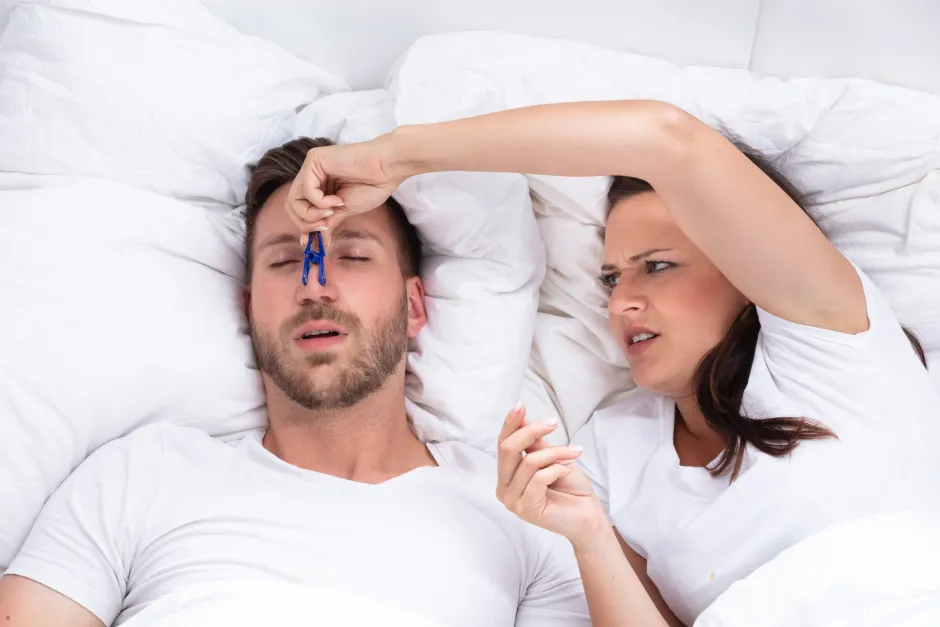
The nocturnal disturbance of your partner's sleep is not only annoying, but also sleep-robbing for the person affected. Normal snoring resembles the rustling of leaves, while loud snoring can reach up to 70 decibels - which is equivalent to the volume of a lawnmower. Middle-aged people in particular are affected by snoring.
But how exactly does snoring, also known as ronchopathy, actually occur?
During sleep, all the muscles in the human body relax.
This includes the tongue, which sinks backwards when relaxed and can block the palatal arch in the throat area. When the outflowing air meets the resulting obstacle, it has to pass through the area under increased pressure - which causes the soft palate to vibrate strongly, resulting in the typical snoring sound.
It is not only the relaxed tongue muscle that can cause snoring, but also the uvula and palatal arch, which descend deeper during sleep and narrow the airways. Men are more often affected by snoring than women, which is due to the anatomical differences between the two sexes.
Women are under the influence of the female hormone oestrogen, which gives their throat and pharyngeal muscles increased tension and stability. Men, on the other hand, have a narrower throat and softer throat muscles, which makes them much more susceptible to snoring.
Snoring does not only occur in the mouth, but can also have its cause in the nose. If the air cannot pass through in a straight line due to swollen mucous membranes or other impairments, disturbing noises occur.
Smoking is also a factor that should not be neglected. Cigarettes irritate the sensitive mucous membranes in the mouth and throat and can lead to swelling, which becomes noticeable at night through loud noises.
Endogenous factors:
Anatomical conditions such as enlarged tonsils, nasal polyps, curvature of the nasal septum or misaligned jaws can favour snoring. Being overweight also leads to an enlargement of the fatty tissue in the throat, which results in a narrowing of the throat area. Women experience increased snoring during pregnancy, which can be attributed to weight gain. Furthermore, people who suffer from hay fever or a house dust allergy often struggle with the annoying noises during sleep due to the swollen nasal mucous membranes. Have you got into the habit of breathing through your mouth? Mouth breathing not only leads to reduced oxygen intake and bacteria formation in the mouth, but also to increased snoring.
Is the cause of your snoring in the mouth area, for example due to a swollen nose or overly relaxed mouth and throat muscles? A snoring splint, which is similar to a brace, can provide quick and effective relief. It creates appropriate tension in the lower jaw, fixes the tongue and keeps the airways clear throughout the night.
Snoring is annoying, but usually harmless.
In rare cases, there is sleep apnoea, which can be dangerous for the person affected if left untreated. The slackened tongue and throat muscles close the throat so tightly that air can no longer pass through properly and breathing stops. However, thanks to modern medicine, sleep apnoea can be successfully treated in several ways.
Where does snoring come from?
Why some people are affected by snoring and some can sleep through the night without making a sound depends on various exogenous and endogenous factors.
Exogenous factors:
In many cases, the sleeping position plays an important role.
If you lie on your back while sleeping, you run the risk of gravity lowering the tongue muscles into the back of the throat.
The consumption of sleeping pills and alcohol can also be the cause of excessive snoring: The substances they contain cause the entire musculature to relax excessively.
What are the possible causes of snoring?
Snoring can have various causes. Obstructed nasal breathing, adenoids, sinusitis, swollen tonsils, etc. can be responsible. Ultimately, any cause that impedes the flow of air through the airways during the night can trigger snoring. The same applies to obesity or natural physiognomy. In most cases, an interdisciplinary clarification of the cause of snoring with various specialists is necessary to determine the actual cause.
The airways must be kept clear so that the body is supplied with sufficient oxygen during sleep. Blocked nasal breathing in particular is often the reason for inhaling through the mouth.
You should therefore consume few liquids shortly before going to bed, as this causes the tissue to swell and narrows the airways. Alcohol in particular, which counteracts muscle tension and causes internal tissues to slacken, is inadvisable. The consumption of cigarettes and other tobacco products also irritates the mucous membranes, causing them to swell. In addition, non-functional methaemoglobin can form, which restricts oxygen transport.
If you are allergic to tree pollen, for example, which tends to fly around at night, you should close your window and take anti-allergic medication if necessary.
Even large meals before sleep, which fill your stomach and intestines excessively, can trigger a slight diaphragmatic shift. This also causes your lungs to shift upwards a little and prevents you from using your upper airways. For these reasons, it is also advisable to regulate your weight and be aware of positive effects such as reducing sleep apnoea with a small amount of weight loss.
Your sleeping position is also crucial. Lying on your back and high pillows are suboptimal because they create unfavourable tongue positions and block the airways. A slightly upward tilted sleeping position in the head area stops the redistribution of the body's own fluids towards the head, which can also cause soft tissue in the neck to swell when the body is otherwise lying flat.
How can I tell if I snore?
When the lower jaw slides back in a relaxed position during sleep, the tongue falls back and the air flow between the palate or soft palate and tongue is reduced. When the mouth is opened, the uvula and soft palate vibrate more strongly due to the slightly constricted airflow. The affected person often does not notice the snoring themselves, but suffers from xerostomia (dry mouth), hoarseness and a sore throat. Sleep disorders caused by a lack of oxygen (sleep apnoea) can also lead to considerable health problems for the snorer. Anyone who suffers from a mild form of sleep apnoea can be helped with a bite splint, also known as a snoring splint. Snoring splints are available as two-part biblock or one-part monoblock splints.
How does a snoring splint/protrusion splint work?
The term "protrusion splint" is derived from the Latin protrusio "to push forward", as this splint is connected to each other by a joint and thus slightly pushes the lower jaw forward and counteracts hypoapnoea (reduction in airflow due to narrowing of the airways). This advancement of the lower jaw through the mouthpiece (snoring splint) optimises mouth breathing and thus prevents snoring during sleep with optimum wearing comfort and free of side effects.
First, the dentist takes an impression of the upper and lower jaw to produce two plastic splints (the snoring splint), which are connected by a small metal joint. This construction is then used to gently move the lower jaw forwards during sleep.
The distance and position of the jaws to each other in the mouth can be individually adjusted by connecting the joint. The splint thus keeps the lower jaw in the optimum position. The resulting change in position due to the snoring splint means that the tongue can no longer fall backwards, which usually causes the typically unpleasant noises during sleep.
This keeps the throat wide open and allows more air into the lungs, which saturates the blood with oxygen. This mode of operation is based on the logic of removable braces, but they are only worn at night. CMD diagnostics is a valuable therapeutic aid in making snoring braces and combating sleep disorders caused by snoring. It enables a three-dimensional visualisation of the positional relationships in the mouth and jaw.
How successful is treatment with a snoring brace / protrusion splint?
Scientific studies have shown that the snoring splint reduces snoring in over 90% of dental patients and can significantly reduce sleep apnoea. In America, many dental patients have been wearing these snoring splints for around 15 years. Here in Switzerland, these snoring splints have only been used by dentists for a few years. Apnoea phases occur more frequently in the early hours of the morning. It is therefore important to wear the snoring splint throughout the night.
Questions about snoring splint
-
The simple, uncomplicated manufacture and, above all, the ease of wearing for the patient make the snoring splint an elegant and, above all, quick problem solver. After all, in 90 per cent of cases they can provide relief and lead to the complete disappearance of snoring. The snoring splint, which is customised for the patient at the dentist, is placed on the teeth during the night and worn during sleep, similar to removable braces.
-
Deep sleep without snoring
The snoring splint favoured in our practice is the so-called protrusion splint.
This snoring splint is one of the most commonly used snoring therapy devices. It consists of two plastic splints and is connected to an adjustable centring device via a hook on an adjustment unit (joint). The dentist determines the corresponding direction of advancement of the lower jaw before manufacturing this snoring splint and can use this construction method to produce a customised snoring splint for the patient that fits well.
-
The cost of a splint depends on the material and size. Cheaper standard models are available for as little as CHF 40 to 50 according to the Internet. Slightly customised thermoplastic mouldable splints are available for around CHF 150 in pharmacies or on the Internet. If you have a professional snoring splint with a dental impression taken at the dentist's with subsequent production of your customised splint in a dental laboratory, you should expect costs of around CHF 800 to 1300. Under certain circumstances, your compulsory health insurance may contribute to the costs if its conditions are met.
-
As a rule, statutory health insurance companies do not cover splints that can be used to prevent snoring. However, it is possible that an anti-snoring splint for obstructive sleep apnoea and pathological snoring may be covered by individual supplementary insurance policies as a form of therapy.
-
The SILENSOR-SL® SNORBAN® TAP® anti-snoring splints pull the lower jaw forwards and thus tighten the throat muscles, keeping the airways clear during sleep. In this way, snoring is prevented and you can finally sleep deeply again and wake up feeling really rested. The Snorflex® anti-snoring splint is designed to help snorers breathe more freely during sleep. The splint from Somnofit is simpler and is offered online in a comparison of various price portals from CHF 70.
-
How long the splint can be used depends on various factors. These include the level of stress, e.g. caused by teeth grinding. However, snoring braces can be worn for several years. The braces are often changed when they have become unsightly due to prolonged use, or when new dental bridges or crowns make a new adjustment necessary. The costs of the splints are currently not covered by health insurance companies, so you will have to pay for the snoring splint privately. Only in individual cases does statutory health insurance cover the costs of snoring braces for patients with sleep apnoea.
- Teeth grinding (bruxism) - What treatment options are there and what can you do?
- Dental bridges - What are the advantages and disadvantages and what costs can arise?
- Costs of dental treatment - How are they made up and how can they be minimised?